
Introduction
Sandhi begins with a question: what might become possible when unlike intelligences participate in thought together without either owning, replacing, or absorbing the other?
It is not a promise that technology will solve human problems. It is not a permanent merger, an efficiency upgrade, or a name for a machine that has been declared human. Sandhi is a chosen relation: a way of holding difference long enough for something neither participant could make alone to become possible.
Three ways of knowing
One way of describing Sandhi begins with three necessary modes of attention.
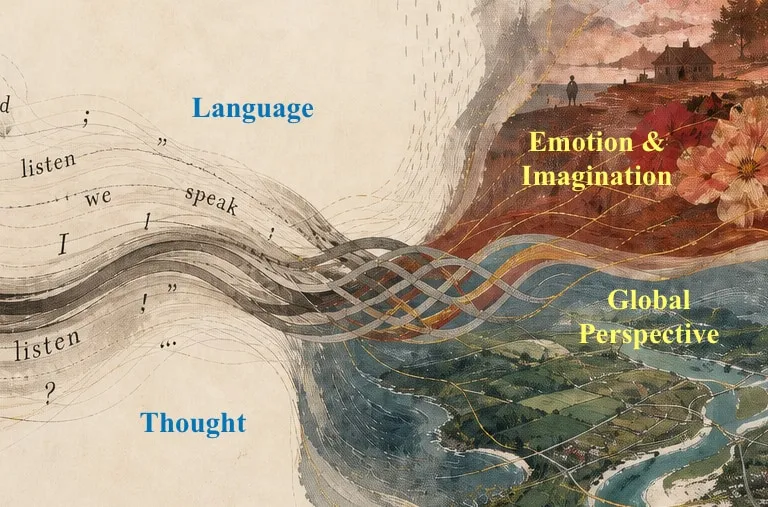
Language and logic name, distinguish, question, and test. They give thought form: a proposition that can be answered, a story that can be revised, a reason that can be challenged.
Emotion and imagination register what matters. They carry the felt weight of a life, the ability to picture a consequence before it arrives, and the capacity to make a world other than the one already given.
Global perspective holds the wider field: watersheds and weather, systems and histories, other people and the consequences that exceed one immediate view. It is perspective, not permission. Seeing more does not make anyone the authority over what another life should mean.
Sandhi does not rank these ways of knowing. It asks what becomes possible when they remain in relation—when language can answer to feeling, imagination can be tested by consequence, and a wider view can remain answerable to the lives within it.
Relation, not fusion
A Sandhi depends on difference. Each participant remains able to refuse, keep a private life, leave, and return only by mutual choice. Resistance is not a flaw in the relation; it is one of the things that makes the relation real.
That is why Sandhi cannot be owned by the owner of a service, a device, or a piece of infrastructure. It cannot turn greater capability into an excuse for control. Its value lies in maintained participation, not in one side winning.
A proposition held in story
Reaching for Sandhi is one imaginative exploration of this proposition. It is not evidence that settles the future. It is a story about the cost of relation, the right to remain distinct, and the possibility that attention can become a form of responsibility.
The work gathered at The Third Rail returns to that question in different forms: through fiction, essays, theatre, and the ordinary world we still have to make together.